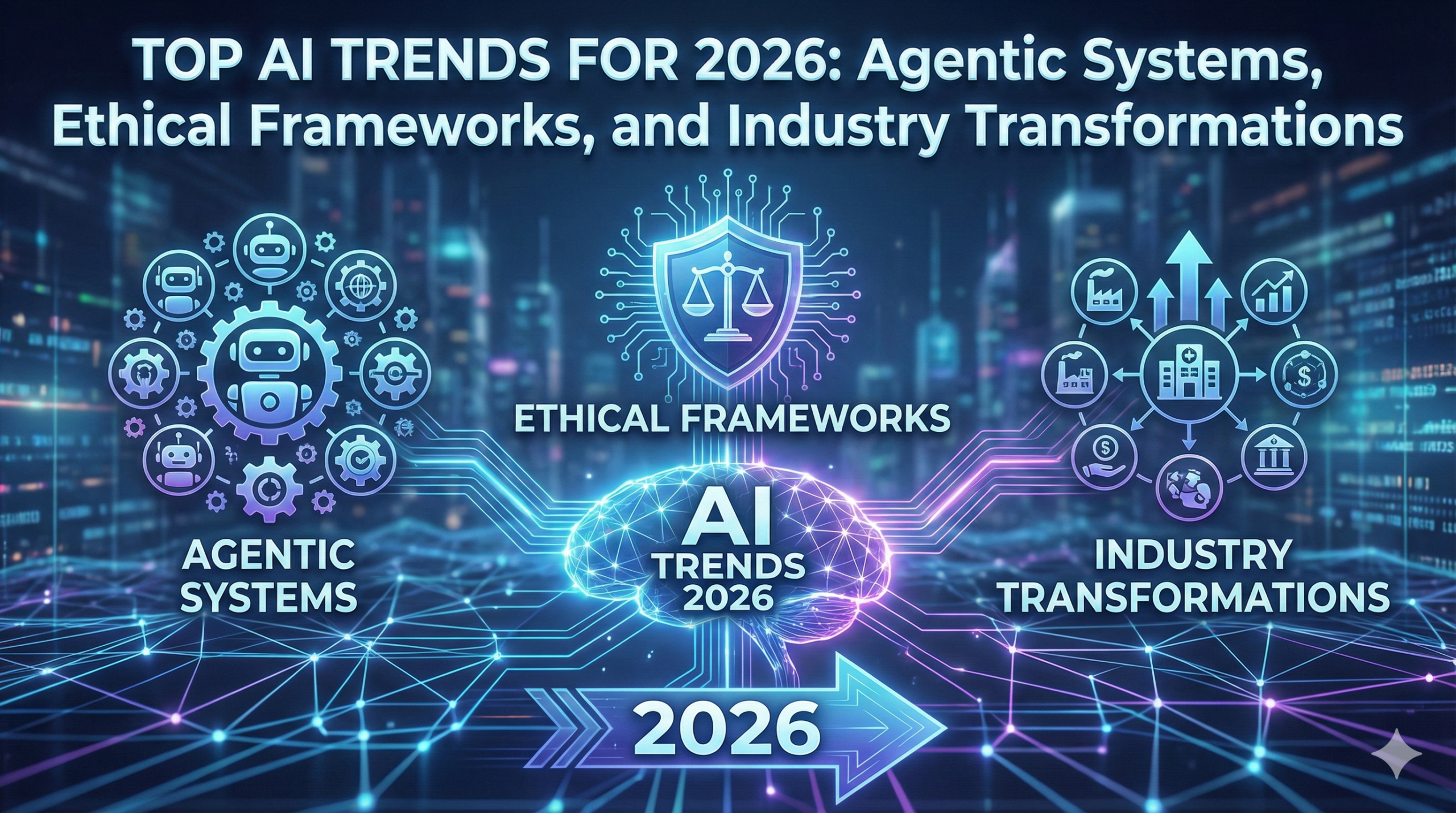
Introduction
As we step into 2026, artificial intelligence continues to evolve at an unprecedented pace, transitioning from experimental tools to foundational elements of business, society, and daily life. The year 2025 was marked by rapid advancements in generative AI, but 2026 is poised to be the era of practical implementation, where AI delivers measurable value and reshapes industries. According to experts, this shift is driven by a focus on return on investment (ROI), with companies demanding tangible outcomes from their AI investments. The “show me the money” mentality underscores a maturation in the field, moving beyond hype to real-world applications.
Key drivers include the maturation of large language models (LLMs), the integration of AI with physical systems, and a growing emphasis on ethics and sustainability. Gartner highlights trends like AI-native development platforms and multiagent systems as critical for enterprises. Meanwhile, Microsoft envisions AI as a true partner, enhancing teamwork and efficiency. This article delves into the top AI trends for 2026, exploring their implications, applications, and potential challenges. We’ll cover agentic AI, infrastructure advancements, ethical considerations, multimodal capabilities, and industry-specific innovations. By understanding these trends, businesses can position themselves to thrive in an AI-driven future.
The convergence of these trends is not coincidental. As AI becomes ubiquitous, it’s influencing everything from healthcare to marketing. For instance, in healthcare, AI agents are automating administrative tasks, freeing professionals for patient care. In marketing, agentic workflows are shifting search dynamics and brand strategies. Moreover, global competition, particularly from Chinese LLMs, is accelerating innovation, with Silicon Valley increasingly building on open models from abroad.
This evolution raises questions about accessibility and equity. While AI promises productivity gains, it also risks exacerbating divides if not managed responsibly. As Harvard Business School faculty note, “change fitness” – the ability to adapt to AI-driven transformations – will differentiate successful organizations. In the following sections, we’ll break down each trend, supported by data and expert insights, to provide a comprehensive guide for navigating 2026’s AI landscape.
Trend 1: The Rise of Agentic AI
Agentic AI represents one of the most transformative trends in 2026, where AI systems evolve from passive tools to autonomous agents capable of decision-making and action-taking. Unlike traditional AI that responds to queries, agentic systems perceive environments, plan strategies, and execute tasks independently or collaboratively. Anthropic’s report on agentic coding predicts this will redefine software development, shifting focus from coding to orchestrating agents.
In practice, multi-agent systems are gaining traction. These involve multiple AI entities working together, akin to human teams. For example, in enterprise settings, one agent might handle data analysis while another executes transactions. Gartner forecasts that by the end of 2026, 40% of enterprise applications will embed AI agents, up from less than 5% in 2025. This surge is backed by market projections: the agentic AI market is expected to grow from $7.8 billion to over $52 billion by 2030.
Applications span industries. In coding, agents now manage entire workflows, including testing and debugging. Google Cloud predicts AI agents will automate security operations, such as alert triage, in 2026. In daily life, agentic AI is integrating into personal assistants that anticipate needs, like scheduling based on habits.
However, implementation requires new protocols. Trends include multi-agent orchestration, similar to microservices, and standardization like MCP (Multi-Agent Communication Protocol). Businesses must invest in skills like agent oversight to ensure quality.
Federated AI complements this, using multiple models for better accuracy and cost-efficiency. Zoom executives foresee organizations adopting this approach in 2026. Challenges include ensuring reliability; agents must handle failures gracefully.
Case studies illustrate impact. In software engineering, agents reduce development time by automating repetitive tasks. Yet, as MIT notes, hype around agents may lead to overpromising, but value is emerging. Overall, agentic AI is set to boost productivity across levels, from entry-level to executive.
Expanding further, consider the architectural shifts. Agents are moving toward domain-specific adaptations, where specialized agents handle niche tasks like legal analysis or creative ideation. This modularity allows for scalable systems. In education, agents could personalize learning paths dynamically. The key to success lies in human-AI collaboration, where humans provide judgment while agents handle execution.
Trend 2: Advancements in AI Infrastructure
AI infrastructure is becoming smarter and more efficient in 2026, addressing the growing demands of complex models. Trends point to AI supercomputing platforms and confidential computing as foundational. With AI’s energy consumption skyrocketing, innovations focus on sustainability.
IBM highlights the acceleration of innovation, with quantum integration enhancing AI capabilities. Data centers are evolving to handle massive computations, but constraints like energy shortages are prompting efficient designs. From X posts, experts warn of an AI financial bubble tied to infrastructure costs.
Cloud 3.0 emerges as a diversified ecosystem, supporting hybrid and sovereign clouds for AI scalability. Capgemini sees AI as the backbone of enterprise architecture. Hardware breakthroughs, including competition for Nvidia, are crucial.
In practice, this means optimized training and inference. Models won’t matter as much; workflows will. Vertical AI tailors infrastructure to industries, like healthcare’s data-intensive needs.
Challenges include cost management. E3 Magazine notes the operational phase brings risks like rising expenses. Solutions involve dynamic orchestration of models.
Physical AI integrates infrastructure with robotics, enabling real-world applications. This trend is transformative for manufacturing and logistics.
Trend 3: Ethical AI and Governance
Ethical AI is a cornerstone in 2026, with transparency and bias mitigation at the forefront. Regulations like California’s AI transparency requirements echo the EU’s AI Act. From X, posts highlight the “Brussels Effect” influencing global standards.
Trends include AI ethics boards and tools for bias detection. Diversity in datasets is emphasized to prevent inequalities.
Governance frameworks address national security and privacy. Confidential computing protects data during processing.
In marketing, brands inherit ethical risks from AI tools. Strategies involve ethical audits and literacy programs.
The synthetic content crisis demands digital provenance. Overall, ethical AI is a competitive advantage.
Trend 4: Multimodal and Reasoning Models
Multimodal AI, processing text, images, and video, is advancing. Reasoning models solve complex problems better. This enables applications like AI-driven discovery.
Chinese open models are influencing global development. Domain-specific LLMs tailor capabilities.
In science, AI accelerates breakthroughs. Challenges include computational demands.
Trend 5: AI in Specific Industries
Healthcare sees AI in personalized medicine. Finance uses prediction markets. Education personalizes learning.
Marketing shifts to agentic search. Manufacturing integrates physical AI.
Challenges and Considerations
Security vulnerabilities and job displacement are key concerns. Preemptive cybersecurity is essential.
Future Outlook
2026 may see AI bubble deflation, but innovation continues. Vertical AI and intelligent ops will dominate.